
Jared Qwustenuxun Williams: A Celebration of Indigenous Food and Cooking
By Katherine Maas
Watch the full video → Lunch & Learn on YouTube
In his May 30, 2025, Lunch & Learn with WE-CAN, Jared Qwustenuxun Williams gave us much more than the promised discussion of Indigenous food and cooking. By contextualizing the topic within the larger domain of how his people lived, cultivated, and harvested traditional foods for thousands of years before Europeans arrived here, he gifted us with a deeper understanding of what was lost to colonization, as well as the hope that if we improve the way
we treat the land we live on, we will get better foods with lower impact on the ecosystem.
Jared’s education in the ways of his people began because he was one of the first generation to not have to attend residential school, where children were forbidden to use their native language and cultural practices. His grandmother, who still spoke the language and knew the stories, had been waiting for the opportunity to share her knowledge, and she became his teacher.
Leaders in his traditional culture were not the 1% at the top of the pyramid, as we see in colonial culture, and wealth was not hoarded but shared. His nation was a matriarchy; leaders were chosen by women, and a leader who proved unfit for the role would simply be replaced. Resources were not just accumulated; they were passed around. “We were all wealthy because we shared.” Names were genealogical, handed through many generations, reinforcing the belief that what you did was a reflection on your whole family.
Contrary to the European belief that the native people of the Americas were merely hunter-gatherers, the First Nations actively managed and cultivated their food sources. In his talk, Jared shared many examples of how Indigenous people actively cultivated their food sources and what impact this had on the environment.

To cite just one example, when Europeans arrived here, they were amazed at how abundant salmon stocks were, assuming this was the natural state of things. But this abundance was no accident; it was the result of many generations of Indigenous people using weirs to harvest salmon. Their weirs enabled them to selectively harvest primarily weaker male fish while allowing all the others to swim upstream to spawn. This ensured each subsequent generation was stronger, because weaker fish were being removed from the gene pool, and more abundant, because weaker male fish were prone to deliberately destroy nests of breeding salmon. When colonists began to prevent Indigenous people from using traditional fishing practices, salmon stocks began to decrease. Modern-day overfishing has worsened this problem so that today we are lucky to see 30,000 fish in a stream where millions used to swim up to spawn every year.
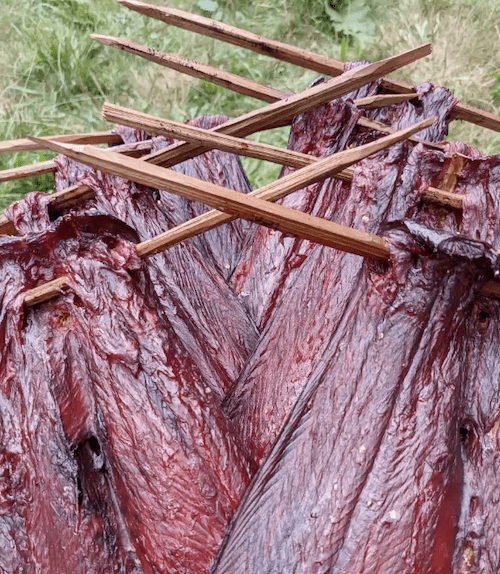
Traditional food production fosters culture. Today Jared brings his own son to work on a weir, teaching him how to build it, how to repair it, and how to smoke the fish he caught to preserve them for the winter. He knows that long after he is gone, his son will remember this, and will be able to say, “I remember working on a weir once when I was a small child, with my dad. And the knowledge of how to harvest salmon sustainably will have been passed down to future generations. “If we don’t eat smoked fish, we don’t remember how to do all these things.”
A video is available of Jared’s full talk, offering many more stories and examples of how Indigenous food and culture are intertwined, and how traditional ways of producing food benefit the environment.