Member Spotlight: The Council of Canadians – South Okanagan Chapter

Member Spotlight - Council of Canadians South Okangan Chapter

By Joslin Jose, WE-CAN Director, and Avi Dolgin, WE-CAN Volunteer

People - Planet - Democracy, The Council of Canadians, South Okanagan Chapter

If you take the route from Vancouver, Highway 1 takes you east to Hope, where Highway 3 – the Crowsnest Highway – continues east through the mountains toward the South Okanagan. As the landscape unfolds, the dry, sun-soaked valley gives way to vineyards, orchards, shimmering lakes and sweeping mountain views – the distinctive landscape of the valley.

Known as one of Canada’s premier wine regions, the South Okanagan is a valley shaped by its warm climate, spectacular sunsets, and thriving agricultural and wine industries.

But beneath this beauty, the valley is facing a growing threat: water scarcity.

According to an article published by Global News on June 29, 2026, the valley is entering its fourth consecutive year of drought, with the province declaring a Level 5 drought—the highest warning on BC’s scale. As the article notes, the crisis “didn’t begin with the scorching summer heat, but began months ago, high in the mountains where winter failed to deliver enough snow.”

The consequences are already being felt across the region. The same report states that of the 35 groundwater monitoring wells in the Okanagan, only seven are within the normal range, while 16 are at their lowest levels ever recorded.

As concerns over the valley’s water supply and future continue to grow, local communities and organizations are looking for ways to respond.

Among them is the Council of Canadians South Okanagan Chapter, a group working to bring issues of climate, community and social justice into the local conversation.

THE COUNCIL OF CANADIANS – SOUTH OKANAGAN CHAPTER

The South Okanagan Chapter was founded in May 2024. It covers the Okanagan Valley from Peachland to Osoyoos,is centred in Penticton, and counts 50 members. Its work focuses largely on water, social justice, transportation and heat, with the goal of building an age-friendly community.

“Our subtitle is people-planet-democracy. You have opportunities to show that bridging in ways that really demonstrate that, for us, climate justice is social justice.,” says Avril Torrence, co-chair of the Chapter.

“Compared to other groups, what makes us stand out is the fact that we are intersectional,” she adds.

That approach can be seen in the chapter’s work on public transportation — an issue that, at first glance, may appear separate from the environmental challenges facing the South Okanagan.

The chapter members regularly meet with MPs, MLAs and city councillors and speak at council meetings.

“We go to council meetings. We write to the government frequently, and explain to them when they are not actually following their own stated objectives, with respect to climate in particular. So we both applaud and critique — and write a lot of letters. Judy Wyper, co-chair, Council of Canadians South Okanagan Chapter, also writes letters to government officials, and we write articles for the local newspapers all the time. If we engage in actions, Lori Goldman, who is a Board Member of First Things First Okanagan and Seniors for Climate South Okanagan, is really good at making sure there’s a media advisory in advance, and a follow-up, too, to get coverage in local paper and digital media,” Torrence mentions.

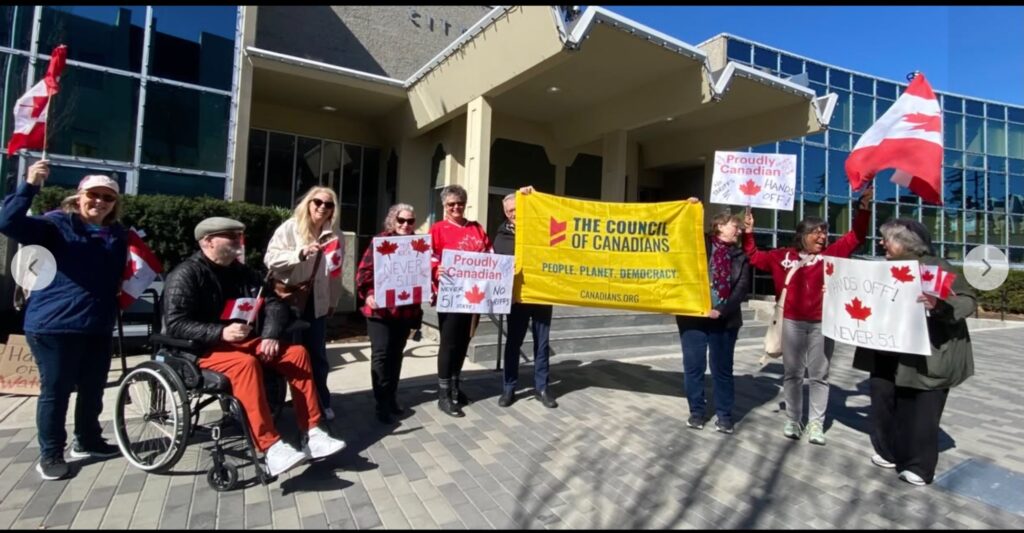
Council of Canadians Rally
In picture: The chapter at one of their rallies.

WORK FOR PUBLIC TRANSIT

“In fall 2024, we participated in a campaign from Council of Canadians chapters to advance public transit across British Columbia. That seemed like an obvious choice for our area, given that we’re poorly served by transit across the valley -it’s a real patchwork. There was a postcard campaign to the B.C. government, and we continue to use the postcards where they seem appropriate,” Torrence says.

The chapter has continued that work and is now part of the Public Transit Alliance of BC.

“We work with the alliance — not at the board level, but in the background — helping to promote and amplify the need for public transit from a profound climate perspective,” Torrence says.

For a region facing increasing environmental pressures, transportation is another part of the larger climate conversation. The chapter’s involvement reflects its broader focus on connecting environmental concerns with the everyday needs of the communities it serves.

MEASURES TO DEAL WITH THE HEAT

The chapter has also turned its attention to the growing impacts of extreme heat, as the South Okanagan continues to experience the effects of drought and increasing heat.

“We have recently partnered and allied with the BC Heat Collaborative,” mentions Judy Wyper.
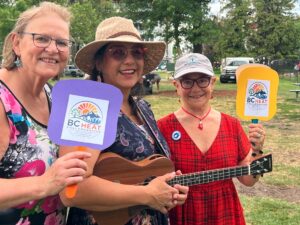
BC Heat Collaborative BC Heat Collaborative sign

In picture: The team at June, 2026 BC Heat Collaborative event

The partnership adds another dimension to the chapter’s work. They also work to raise awareness among voters, councils and municipal governments to ensure that heat is taken into consideration as an important factor when preparing city plans.

Torrence points out, “In the heat dome discussion, they put out an extreme heat plan for vulnerable populations. I was at the city council meeting and had to point out to them that they did not even include, within their report, the urban tree plan that the city itself has. Now, it strikes me as someone interested in climate and climate justice that tree cover and tree plans should be part of an extreme heat report. “

WATER – THE MAIN FOCUS THEN AND NOW

The Chapter organized month-long activities around World Water Day in March 2026, aimed at spreading awareness and educating people about the severity of the water scarcity situation — even in a land punctuated by lakes. 
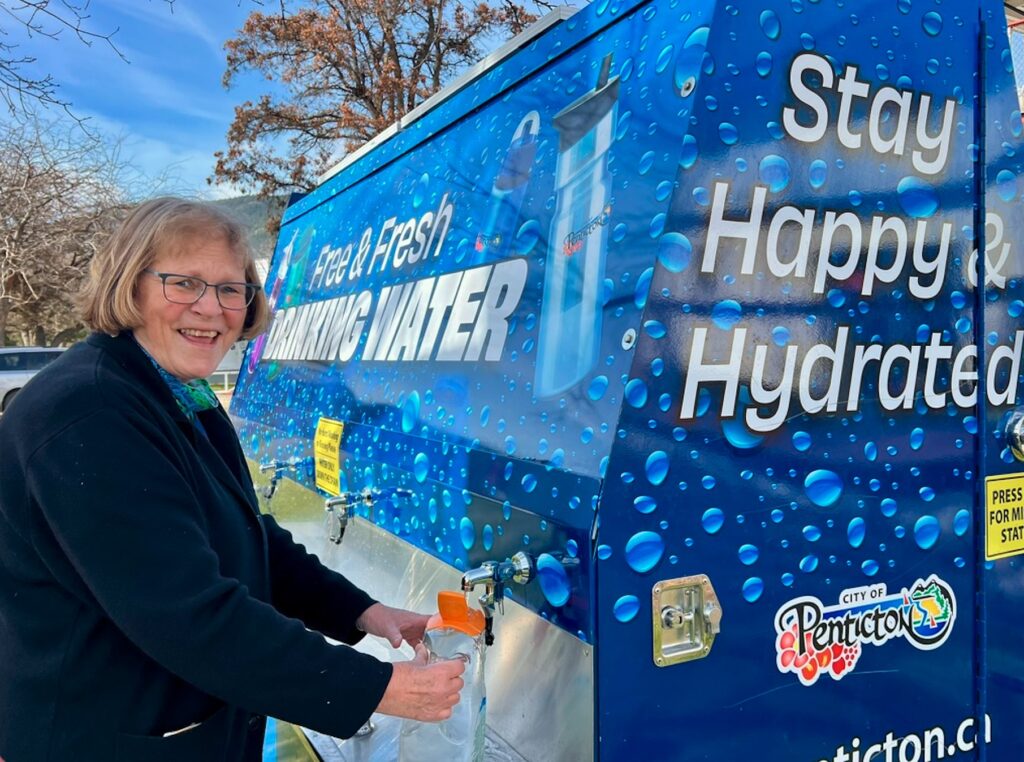
Avril Torrence World Water Day
In picture: Avril Torrence at the 2026 World Water day event

“We are in a water scarcity situation, and that’s a level higher even than drought. Drought is occasional, and water scarcity is prolonged,” says Wyper.

“We are in serious trouble, but it’s easy for people to not get it, as it were, because we are within the lake region. So we approached water relative to Indigenous populations, and focused strongly on salmon in the Okanagan and Similkameen regions. Part of that water month was touring a fish hatchery with Penticton and the Okanagan Nation Alliance,” Wyper explains.

“I would venture to say we are largely a water organization when it comes to climate, but not exclusively so. At the end of March, Judy, myself, and Lori Goldman presented the capstone event on water at a lunch-and-learn meeting in our community. We came at it from different perspectives,” says Torrence.

“As part of the community, we offered a tour of Penticton’s water treatment plant, where our public water is made potable and usable, and the fish hatchery. We also included the Sicamous paddlewheeler on Okanagan Lake. Both the fish hatchery tours and the water treatment plant tours were fully oversubscribed, which brings awareness to our group — people leave those events with ‘Keep Water Public’ stickers to put on their water bottles. I have a button that says, ‘I drink tap water!’,” she adds.

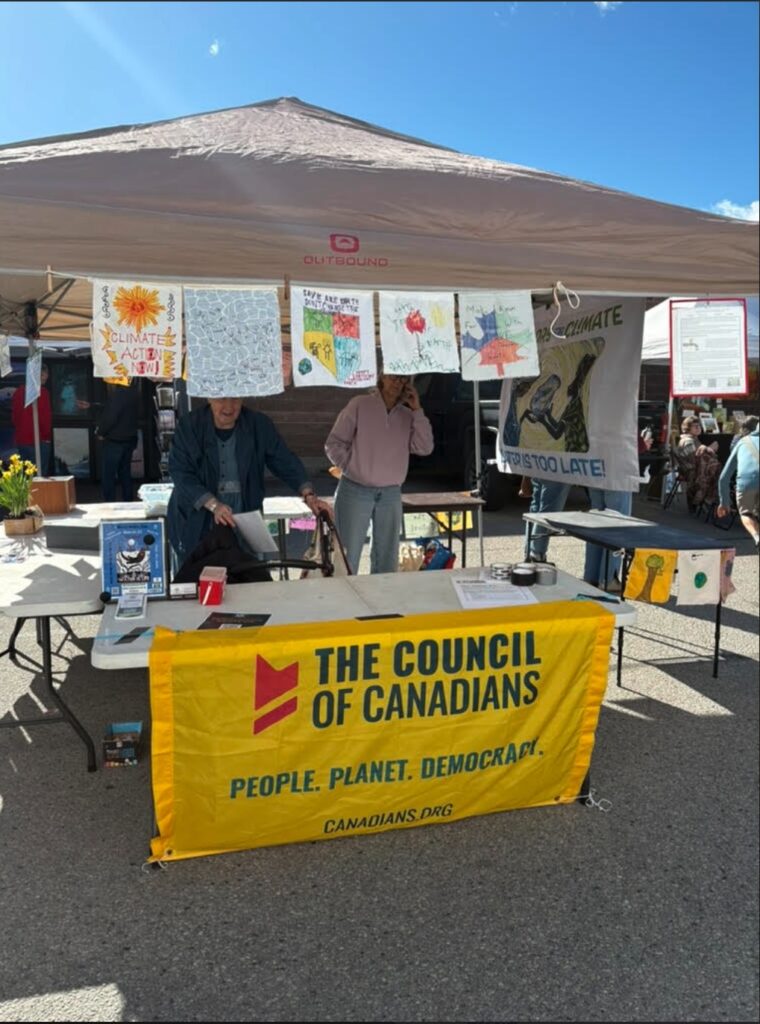
Climate Prayer
In picture: Climate Prayer Flags of Hope- World Water Week BC 2026

The team’s table shared with the local Seniors for Climate group in March 2026 to launch series of water events


“I came to the Council of Canadians interested in water because I’d long been part of the Peachland Watershed Protection Alliance,” mentions Wyper.

“We’re working here in Peachland to protect our water source, and dealing with forestry issues – lots of activism, talking to our MPs and MLAs, and sending petitions to stop clear-cutting and to use better forestry methods that would protect the environment and the ecosystems. Our chapter co-sponsored a documentary screening and presentations about how current forestry practices impact communities,” she adds.

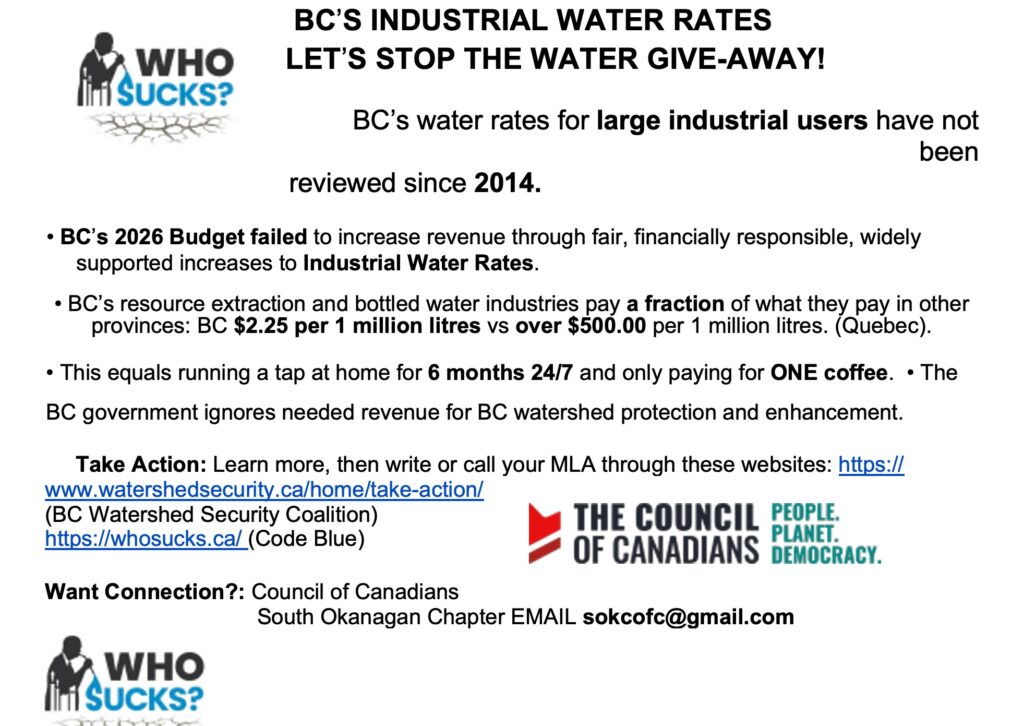
BC Industrial water rates
In picture: The handout used by the chapter to draw attention to concerns over the government’s handling of industrial water use.

LOOKING AHEAD

Torrence rightly states, “Allyship is our strength.”

“I think the power of connecting with other groups is not to be underestimated. The statement, ‘We don’t want allies—we want accomplices,’ really resonates with me. If I’m your accomplice, I’m required to do something more than just be your ally, and I like that notion. That’s one area where, even though we live in very close alignment with Indigenous communities, we could always build stronger connections and actually work together as accomplices,” she adds.

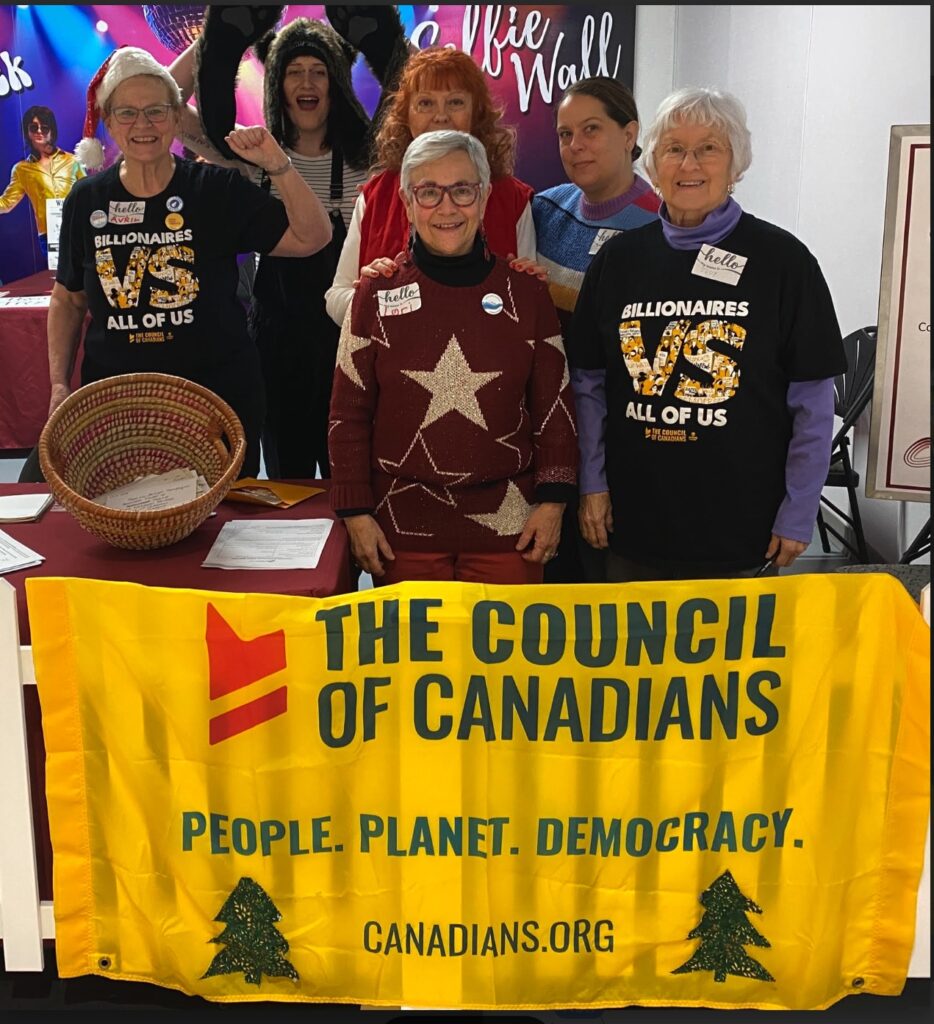
Council of Canadians
In picture: Christmas Cards to Elected December 2025 Event Avril Torrence, Lori Goldman, Judy Wyper and Council of Canadians leaders

From public transportation to extreme heat, the Council of Canadians South Okanagan Chapter is approaching local challenges through the lens of people, planet and democracy. In a valley increasingly shaped by drought and water scarcity, they are working to ensure that climate concerns remain connected to the needs and realities of the people who call the South Okanagan home.

Resources for Further Reading:


1. Water crisis in Okanagan: https://globalnews.ca/news/11941030/drought-okanagan-leaders-unite-protect-water-supply/

2. Reports on water scarcity: https://syilx.org/water-scarcity-levels-set-to-high-across-the-okanagan-watershed/

3. Read about the Okanagan Similkameen Collaborative Leadership Table to protect and restore water in the region:
https://syilx.org/programs-services-and-initiatives/fisheries-and-natural-resources/siw%c9%ack%ca%b7-water/okanagan-similkameen-collaborative-leadership-table/

4. Water advisory issued: https://www.castanetkamloops.net/edition/news-story-623687-87-.htm#623687

5. S S Sicamous paddle ship: https://www.sssicamous.ca/ships-of-the-okanagan

6. Read the Peachland Post: https://peachlandpost.org/