
By Joslin Jose, WE-CAN Volunteer, with Avi Dolgin
Winter Holidays, A Friday Evening at the Rogue’s, Duncan, BC
Today is an important day for the Rogues. They have been invited to host the annual Christmas dinner at the Walkers’, a tradition they cherish. Every year, Captain Sam and Maria attend, and over time, their bond with the Walkers only grows stronger. This year, Sam has been asked to host the gathering on their behalf, a great honour, and one more reason to arrive early. But tension fills the room.
Captain Sam discovers that his car has a gas leak and won’t make the 55-minute drive from Duncan to Victoria. It is already 6 p.m., and dinner begins at 8.
“Do you think we should take transit?” Sam asks Maria.
Frustrated and rushed, they grab their coats and hurry toward the bus stop five minutes from their home, hoping to catch a bus in time.
They wait. And wait. No bus appears. The cold deepens, their legs grow tired, and still there is no sign of service.
Sam finally approaches a man standing nearby.
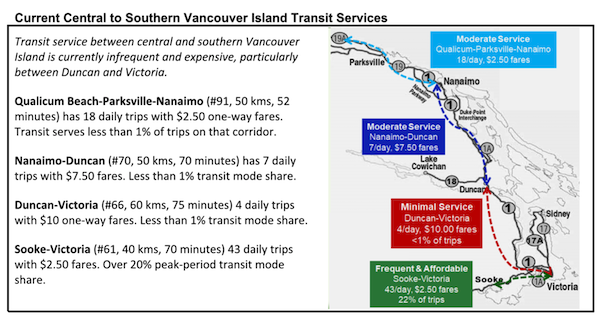
“There’s no evening bus going to Victoria,” the man says. “The #66 only has four morning departures to serve commuters to Victoria. It does not operate in the evenings or on Sundays, and the fare is ten dollars each way. It’s been like this for years.”
Sam feels a sinking frustration. He always assumed that public transit would be available when he needed it—not leave people stranded.
“This is exactly why we struggle without a car,” Maria sighs.
A taxi is their only remaining option; they hesitate after checking the fare—over a hundred dollars each way—but finally call the cab.
By the time they reach Victoria, the dinner has already begun. Sam can’t shake the disappointment of missing the chance to host. It isn’t just about being late; it feels deeply unfair.
Later that evening, he and Maria listen to other guests share similar stories: seniors missing medical appointments because buses don’t run late enough, workers unable to take jobs in neighbouring towns, young people cut off from opportunities, drivers spending hours chauffeuring family members to other towns.
It dawned on Sam that their small ordeal reflected a much larger problem. In 2024 the provincial government promised to provide frequent and affordable inter-community bus connections on Vancouver Island and along major highways, but it has failed to act. Meanwhile, people without cars, seniors, students, workers, families, continued to pay the price, and so did the small-town economies that depended on reliable connections.
That night, Sam realized the story wasn’t just about missing a Christmas dinner. It was about a province failing to provide the essential transportation services that keep communities connected, and about countless people left without viable options.
BETTER ISLAND TRANSIT
Recognizing the challenges faced by residents like Captain Sam, Maria, and many others who struggle with limited, inconvenient and costly transportation options on the Island, more than 50 activists and community members formed Better Island Transit (BIT) in 2023. The group advocates for safe, accessible, and affordable bus service across Vancouver Island.
Transportation planner and BIT President Todd Litman explains, “One of the insights of my work is that transportation planning today is biased toward automobile travel. A transportation planner typically evaluates performance based on speed, using indicators like road level of service, average traffic speeds, or hours of congestion delay. The assumption is always that faster is better. They do not consider affordability, inclusivity, resource efficiency, or health impacts.”
BIT members conduct research and publish reports on the practical challenges of car ownership, and the difficulties residents face when relying on public transit to move around and connect with the Island. They also evaluate the benefits of walking, biking, and using public transit.
ASSESSING GAPS IN TRANSPORTATION INFRASTRUCTURE
A study conducted by the team on Island transit routes, fares and demographic data points to significant gaps in providing frequent and cost-efficient transportation for travellers moving between Duncan and Victoria.
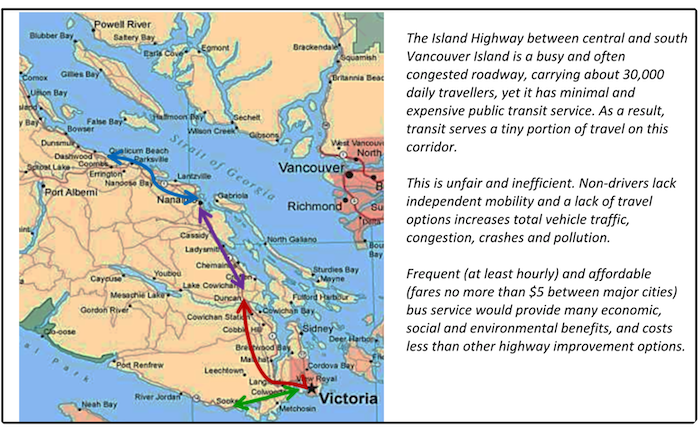
“Between Victoria and Duncan there are only four daily commuter trips; there is no off-peak or reverse commute service, minimal weekend service, and the $10 fare is four times a local bus trip. Between Duncan and Nanaimo there are seven daily trips with $7.50 one-way fares. Because it is inconvenient and expensive, public transit only carries a tiny portion of trips. In contrast, the #61 Sooke-Victoria bus has 43 daily trips with $2.50 per trip fares and carries 22% of peak-period trips.”
–Frequent and Affordable Vancouver Island Bus Service, 6 June 2024, Better Island Transit
LOBBYING
“The #66 bus that connects Victoria and Duncan only makes four daily trips, all designed for Duncan commuters to Victoria, with no evening or Sunday services and $10 one-way fares (www.bctransit.com/cowichan-valley/schedules-and-maps/commuter). The #70 connecting Duncan and Nanaimo is a little better with nine daily trips, but is still inadequate for most trips. For example, the latest departure is at 7:30. A taxi fare from Victoria to Duncan is more than a hundred dollars and to Nanaimo is twice that,” mentions Litman.
“The current provincial governing agreement commits the province to providing frequent and affordable transit connections on Vancouver Island and other major highways, but has so far failed to act. We are lobbying for this,“ he adds.
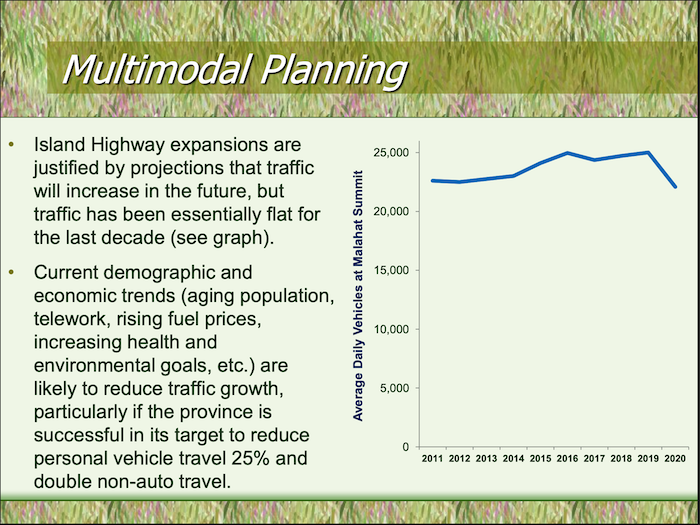
The Ministry of Transportation also plans to spend $162 million to expand the Malahat Highway through Goldstream Park in order to add 1.5 kilometres of safety barriers, but this project faces opposition from First Nations and environmental activists due to its potential waste and risks.
“This project is also environmentally and culturally harmful. Blasting, destroying 700 shade trees, building a river bank retaining wall, and replacing a natural riverside trail it with a cantilevered metal walkway destroy and disrupt critical habitat. Motor vehicle traffic, including electric vehicles, is harmful because of harmful pollutants it introduces a chemical known as 6PPD-quinone that is particularly toxic to salmon (Chadwick 2024).” Protecting Goldstream Park- Better Alternatives to Highway Expansion by Todd Litman ,12 July 2024
“We are trying to convince the Ministry to instead invest in frequent and affordable bus service. That would provide far more safety and greater total benefits by improving transportation on the entire corridor from Victoria to Nanaimo,” says Litman. (UPDATE: The Province has just backed down on this plan.)
TRANSPORTATION IS FOR ALL
Todd Litman and his team also actively focus on ensuring that transportation amenities are accessible to everyone—regardless of race, gender, or disability. They also provide policy recommendations that can help create a more efficient, fair and sustainable transportation system in British Columbia.
“What are the differences in mobility between First Nations, Black, and white populations, or between women and men? How does mobility differ between someone who owns a car and someone who doesn’t, or between a person with a physical disability and someone who is physically able? These questions naturally lead us to consider differences in mode of transportation.” explains Litman.
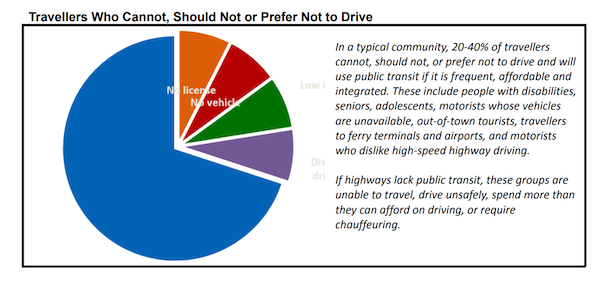
“Many non-drivers have low-incomes or disabilities, and many belong to disadvantaged and isolated communities. Shifting the debate from a categorical analysis, such as race, to a functional analysis, such as income level, physical disability, or whether someone is a driver or non-driver, actually improves the ability to justify investments in non-auto travel.” he adds.
A MULTI MODAL APPROACH
Assessing the current transportation infrastructure, Todd and his team are researching the possibilities and advantages of multimodal transportation.
“If we had a more multimodal transportation system, it would be easier to live without a car and to get around by non-auto modes. What I can demonstrate is that everybody benefits, including motorists,” Litman explains. “In an automobile-dependent area, drivers spend a great deal of time chauffeuring the non-drivers in their families. This is especially true for parents of children between, eight and eighteen; you end up spending an enormous amount of time driving them everywhere. Motorists are far better off when they have good public transportation, safe walking routes, and reliable bicycling infrastructure, because it reduces their chauffeuring burden and, in some cases, even eliminates the need for a second car.”
“I’m trying to bring that into political activism,” he adds. “We need to ask how we can ensure that local governments invest adequately in sidewalks, crosswalks, and lower traffic speeds—so it becomes safer for everyone, especially vulnerable groups like children, seniors, and people using wheelchairs, to get around without a car.”
DETERMINED TO MAKE ISLAND TRANSIT BETTER
Drawing on his own experience of living without a car for more than fifteen years, Todd and his team dedicate themselves to making travel by public transit easy, accessible, safe, and affordable for everyone on Vancouver Island.
They advocate for safe sidewalks and pedestrian-friendly crosswalks instead of high-speed highways, and they campaign for equitable, basic transportation options for every family member—from 65-year-old Captain Sam to his 90-year-old father. They work to bridge the Island by pushing for transportation systems that close mobility gaps and guarantee that no resident is left behind.
Resources for Further Reading:
- Better Island Transit: https://betterislandtransit.ca
- Their goals: https://betterislandtransit.ca/goals
- Backgrounder: https://vtpi.org/F&Abus.pdf.
- Media and Press: https://betterislandtransit.ca/news, https://betterislandtransit.ca/media
- Better Island Transit proposal on Why and How to Provide Convenient and Inexpensive Public Transit on Vancouver Island: https://betterislandtransit.ca/reports/2024-02-26-objectives-presentation.pdf